|
Churches
This page has pictures and information
of churches where members of the family were Christened or Married
|
|
St Peter's Church, Boxted, Essex |
|
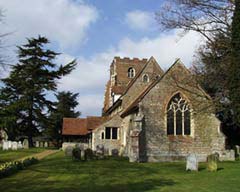 |
The church known as ST. PETER
since 1848, formerly St. Mary, has a chancel, nave with north and
south aisles, south porch, and west tower. Built primarily of rubble with
puddingstone and Roman brick, the nave, chancel arch, and tower are early
12th-century. The out lines of the original high windows remain above the
north arcade. The aisles were probably added in the mid 14th century when
the clerestory and the surviving crown-post nave roof were made. About the
same time the small west window in the tower was replaced, and two windows
were inserted in the east wall of the nave above the chancel arch.
John Warren and Harriett
Lilley were married here on 31st January 1871. |
| |
|
|
|
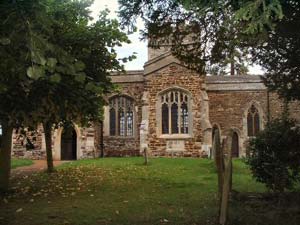
Parish Church of St Luke, Stoke Hammond |
|
The church of ST. LUKE
consists of a chancel, central tower, north and south transepts, nave,
south porch and small modern north vestry. There was apparently an
early church here consisting of a chancel and nave, the eastern angle of
the south wall of the latter being still visible in the east wall of the
south transept. In the middle of the 14th century the church assumed its
present cruciform plan, the chancel being rebuilt and enlarged, and the
central tower and transepts added. Standing on high ground at the north
end of the village, it is approached through an avenue of lime trees. In
the churchyard there are two yew trees planted in 1687.
Charles Foster and Hannah
Stevens were married here on 10th December 1855. |
 |
| |
|
|
|
St Marks Church, Clerkenwell |
|
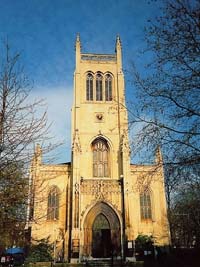 |
Saint Mark's
has stood in Myddelton Square, witnessing to the glory of God, for 178
years. In 1781, the Prince Regent (later George IV) urged Parliament to
provide new churches for the rapidly expanding population of London. In
1822 the Rev'd Thomas Handley of the parish of Saint James, Clerkenwell,
reported that "the parish contains about 36,000 inhabitants and there is
not accommodation in the two parochial churches and chapel for more than
one tenth that number".
William Chadwell Mylne, Surveyor to the New River Company, prepared plans
for a "neat gothic church", following his development of the surrounding
New River Estate in Finsbury in the 1820s. The first stone was laid in
April 1825; Saint Mark's cost about £16,000 to build; and it was
consecrated by the Bishop of London, Dr William Howley (later Archbishop
of Canterbury) on Tuesday 1st January, 1828. The west tower is a handsome
and important feature in the townscape with commanding views across
London, and is floodlit at night.
Frederick
Wormald and Sarah Rebecca Woodman were married here 19th November 1874. |
| |
|
|
|
St Michaels Church, Wood Green |
|
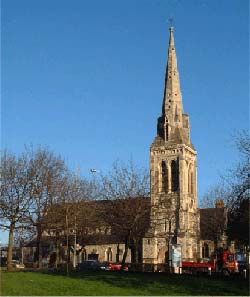
St Michael's stands
majestically at the top of Jolly Butcher's Hill on the junction of High
Road and Bounds Green Road N22. Its undoubtedly one of the most
significant and architecturally important buildings of Wood Green.
Before 1843 the people of Wood Green would walk all the way over to All
Hallows, Tottenham to worship. In 1843 however, they made a request for a
church of their own.
St Michael’s Chapel of Ease was built to designs by Messrs Scott (later
Sir Gilbert) and Moffatt, and was consecrated on October 3rd 1844.
The land the church had been built on was not very stable though and the
building began to crack. Around the same time the population of the area
was increasing rapidly, and the church was considered far too small.
In 1859 it was decided to demolish the old church and build a much larger
Nave – the Nave we see today. In 1871 a new Chancel was added, and a Tower
in 1874 followed by a Spire in 1887 designed by Sir Gilbert Scott.
Henry Porter and Louisa Wood
were married here on 19 June 1886. |
 |
| |
|
|
|
St Mary's Church, Reading |
|
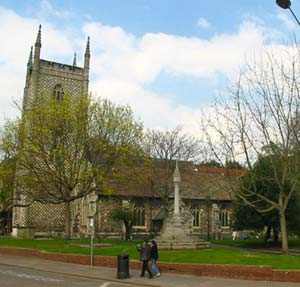 |
The church of ST. MARY THE
VIRGIN consists of a chancel with a modern north organ chamber and quire
vestry, out of which opens an octagonal clergy vestry, a modern south
chancel aisle, a nave, a modern north aisle, the eastern end of which was
originally a north transept, a south aisle, a west tower, and a south
porch.
Little can be said of the early history of the existing building, the
original church having been altered on several occasions and having
suffered badly from the 19th-century restoration, when in 1863 the church
underwent a thorough restoration, the chancel was entirely rebuilt, and
the chancel aisle and priest's vestry were added, and the quire vestry
built. In 1872 the building was again enlarged by the addition of the
north aisle.
George Baker and Maria
Knight were married here on 24th June 1855.
George Hopkins and Sarah
Harris were married here on 11th May 1856. |
| |
|
|
|
Wincanton Baptist Church |
|
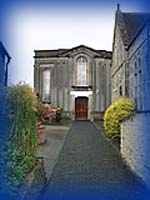
A Baptist church was formed in
1829 by members of a breakaway Congregational meeting. The first
chapel, licensed in 1830 and called the Union chapel, was a
galleried building in Oborn's Yard, off the north side of High Street. In
1832 a new chapel was built in Mill Street which was opened in 1833 and is
still in use today. George Day, minister 1829-57, had been a plasterer and
is said to have worked at Fonthill Abbey and to have been responsible for
the ceiling of the Mill Street chapel. Attendance in 1851 was 120
adults and 100 children in the morning and 180 in the evening. The chapel
is a rendered building with a slate roof and a Doric porch. It stands in a
small burial ground. The Sunday school was built in 1887.
William Edwin Jerrett and
Elizabeth Warren were married here on 12th January 1901. |
 |
| |
|
|
|
Parish Church, Down St Mary, Devon |
|
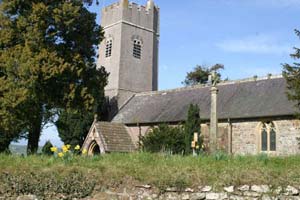 |
The present restored church
was erected probably in the 14th century, but before this there existed a
Saxon church, remains of which can be seen in the present building. The
most remarkable of these is to be found in the tympanum of the south door,
said to date from Saxon times, and representing a male figure in the
centre and animals on either side.
The church consists of chancel, nave, north aisle, south porch, and west
tower containing three bells, two dated 1677 and 1754 respectively. As we
enter the church we notice the Norman arches and pillars, the latter are
monoliths with tracery on the capitals, the font is of granite and of the
same date as the pillars, so it would seem probable that the main part of
the building is not of later date than the 12th century. The south wall
has been entirely rebuilt and faced with stones of various colours. The
sanctuary shows signs of the loving care which has been bestowed upon it.
There is a beautiful reredos, the walls have been covered with alabaster,
and the clergy stalls face eastwards in the old fashion. The glory of the
church is its rood screen.
Richard Jerrett and Susan
Salter were married here 30th May 1867 |
| |
|
|
|
St Olave Jewry, City of London |
|
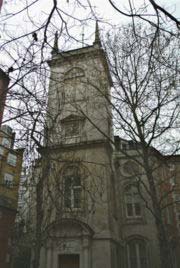
St Olave, Old Jewry was a church in the
City of London located between the
street called Old Jewry and Ironmonger Lane. It is dedicated to the 11th
century patron saint of Norway, St Olaf.
Old Jewry was the precinct of medieval London largely occupied and
populated by Jews until their expulsion from England in1290.
Destroyed in the
Great Fire of London in 1666, the church
was rebuilt by the office of Sir Christopher Wren.
Rebuilding began in 1671, incorporating much of the medieval walls and
foundations. The tower was built separately, projecting from the west of
the church. The church was completed in 1679 at a cost of £5,580.
Despite being restored in 1879, the body of the church was demolished in
1887 under the Union of
Benefices Act. The site was sold for £22,400 and the proceeds used to
build St Olave's Manor House. The dead were disinterred and their remains
moved to llford and
the furnishings dispersed to several other churches. The tower, west wall
and part of the north wall were kept and incorporated into a new building
which included a rectory for St Margaret Lothbury. This was replaced in
1986 by an office building, in a sympathetic style, designed by the firm
of architects Swanke, Hayden, Connell. The churchyard survives as the
courtyard to the office building.
Henry William Woodford and
Eliza Weeks were married here on 1st May 1838. |
 |
| |
|
|
|
Christchurch, Cockfosters |
|
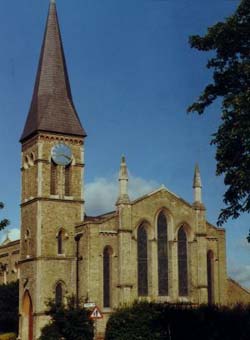 |
Christchurch Cockfosters was
built in 1837-39 when it became a separate parish, and was paid for by
Robert Bevan of nearby Trent Park, a partner in Barclays Bank; the Bevan
family monument can still be found in the churchyard. In 1898 the
orientation of the church was reversed and the chancel, north aisle,
transepts and chapels were added by Sir Arthur Blomfield. The church is of
stock brick, in Early English Style with a thin tower capped with a spire.
The hamlet of Cock Fosters was effectively developed as an estate village
for Trent Park and Beech Hill Park and in the 1860s consisted of little
more than a collection of cottages north of the main gate to Trent Park on
Cockfosters Road, with some larger houses and a pub in Chalk Lane. The
1930s saw the arrival of the Piccadilly Line and substantial housing
development at Cockfosters, which by 1939 was firmly part of London's
suburbia as far as the station at least. However, north of the church from
the junction of Chalk Lane and Cockfosters Road, only a thin ribbon of
wealthy properties has been built along the west side of Cockfosters Road,
and much of the land to the east is still farmed and rural, largely as a
result of the introduction of the Green Belt. The small churchyard to the
north of the church has gravestones and some fine monuments among grass,
with yew and other trees, roses and shrubs planted; a hedge with holly and
hawthorn separates the churchyard from Chalk Lane which has a rusticated
gateway at the north-east corner. There a number of interesting
C19th monuments near the church, including the large Bevan family tomb.
Eric Foster and Patricia
Wormald were married here on 3rd September 1948 |
| |
|
|
|
Church of the Holy Trinity, Colchester |
|
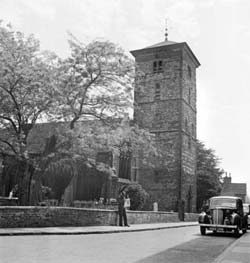
Holy Trinity church tower was built around 1000 AD. Its arrow head doorway
and window apertures are typical of the Saxon period. The remainder of the
church is of different periods up to
Victorian. It is the oldest building in Colchester predating the castle.
During the Anglo-Saxon period many Roman buildings were demolished and
later salvaged to construct buildings like the Holy Trinity tower,
something which the Normans copied on their arrival.
Today the church building is
unconsecrated and for a time was Colchester's Social History Museum.
William Lilley and
Charlotte Cole were married here on 12th June 1848. |
 |
| |
|
|
|
St Dunstan
and All Saints Church, Stepney |
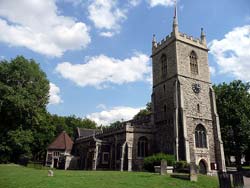 |
People have lived in
what we now call Stepney since about a thousand years before the birth of
Christ. It is thought that the first church was built here sometime
between St Augustine's conversion of the English in the 6th century, and
952 when a second church was erected on the site by St Dunstan.
The first church was probably wooden, and dedicated to All Saints, but it
is thought that St Dunstan built his church here in stone. No part of this
original structure survives, apart from a tenth century stone relief panel
of the Crucifixion, which you can see under the east window.
Some time after St Dunstan was made a saint in 1029, the church was
rededicated to him. In 1896 the ancient dedication of All Saints was
revived, and the two names have been used together ever since.
|
|
In the middle ages,
Stepney became a favoured country retreat for lords and merchants. St
Dunstan's became a place of wealth and importance. It was in this period
that the building took its present shape, with the chancel built in the
thirteenth century and the nave in the fifteenth. Stepney was in the
heart of intellectual life during the Reformation of the sixteenth
century. John Colet, Dean of St Pauls and St Dunstan's most famous vicar,
was one of the leading scholars of the "new learning" from which the
Reformation sparing. His friends Erasmus and Thomas More were regular
visitors to his Stepney mansion. This mansion was the home of Thomas
Cromwell from 1534 and it was from here that he masterminded the
Dissolution of the Monasteries. Successive rectors were staunch supporters
of the new Protestantism, and the parish was staunchly Parliamentarian
during the Civil War.
The population of
London's East End grew hugely and in the eighteenth century the parish was
split, with new churches built in such areas as Bethnal Green,
Spitalfields and Limehouse, to minister to the vast numbers of people who
now sought work in local industries. By Victorian times, Stepney had
a reputation as one of the worst slums in London. Successive rectors
ministered tirelessly for the poor of the parish. In the second world war,
the church miraculously escaped the Blitz that devastated houses all
around it, losing only its windows.
Robert Day and Susanna
Louisa Day were married here on 19th August 1822. |
| |
|
|
|
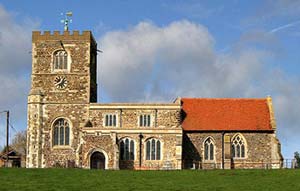
All Saints,
Soulbury |
The walls are of red sandstone
rubble almost entirely covered with plaster and rough-cast, and the
dressings are of sandstone repaired with Roman cement. The chancel, north
aisle and porch have angle buttresses, and the nave and aisles plain
parapets. The chancel roof is tiled, the remaining roofs being covered
with lead.
The original church consisted of a chancel with an aisleless nave. About
the middle of the 14th century the chancel was rebuilt and aisles were
added to the old nave. In the next century new windows were inserted in
the south aisle and the south porch was built. Early in the 16th century,
probably soon after the grant of the church to Woburn Abbey, the arcades
of the nave were rebuilt and the north aisle was extended westward, the
west tower and the clearstory were built, and new roofs were given to the
nave and aisles. A former north porch existed, the line of the roof being
visible over the north doorway of the aisle. In 1863 the church was
restored. |
 |
| |
|
|
|
All Saints, Wing |
|
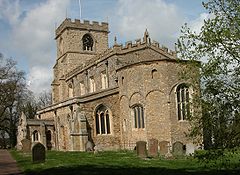 |
Although the date of the
building is not authenticated, it is probably of the 10th century. The
plan was then practically the same as at present, without the west tower
and the north and south porches. The building probably remained in its
original state until the 13th century, when an arch was inserted in the
length of walling to the east of each arcade of the nave. The walls of the
south aisle were rebuilt and windows inserted in the north aisle in the
next century. In the 15th century the tower was built and the clearstory
was added to the nave; the porches were built, more windows were inserted,
and the greater part of the church was reroofed. The church was repaired
at various times in the 17th and 18th centuries, the entries of payments
made for this purpose being preserved in the Churchwardens' Accounts. In
1881 the crypt was cleared of rubbish and repaired, while in 1893 the
whole building was thoroughly restored. |
| |
|
|
|
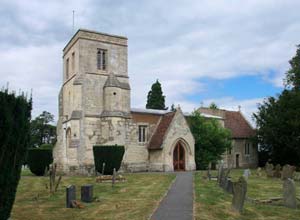
St Giles Church,
Cheddington |
|
The earliest church of
which there is any trace appears to have been built during the reign of
Henry I or Stephen (i.e. between 1100 and 1135). This church must have
been built in the Norman style and its outline is now marked by the
present chancel and nave. Fragments of this old church are to be found
decorating the walls of the porch. Two centuries later (in 1340) the
chancel arch was widened and probably replaced a round headed Norman arch,
but the greatest changes came in the 15 th
century. First the windows of the nave and the chancel were put in (but
not the large east window which is modern). Later the north aisle and west
tower were added thus completing the general outline as it is at present.
All these alterations and additions were built in the Perpendicular style
and so radical were these changes that the church has the general
appearance of a 15th century church. |
 |
|
The addition of an aisle
was usually the sign of a growing population and it was often placed on
the north side of the church as that side was considered unlucky for
burials. There was therefore room on the north side for the building of an
extension and this was apparently the case here at Cheddington.
By the middle of the 19 th
century the
church needed thorough restoration and this was carried out in 1855. The
chancel was newly roofed and the east wall of the chancel with its large
window entirely rebuilt. The south porch underwent complete restoration
and a new vestry was built on the north side of the chancel. |
| |
|
|
| |
|
|
| |
|
|
| |
|
|
| |
|
|
| |
|
|
| |
|
|
| |
|
|
|